Reconstructing the State's Right of Control Paradigm from a Prophetic Law Perspective
DOI:
https://doi.org/10.31292/mj.v6i1.242Keywords:
State Right to Control, prophetic law, agrarian justice, UUPA , Prophetic TriangleAbstract
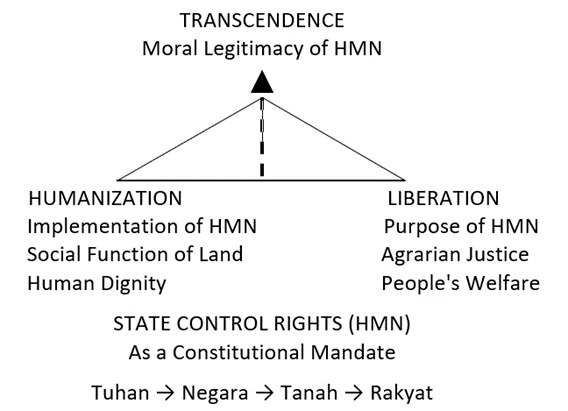
The interpretation of the State's Right to Control (HMN) in agrarian law is still dominated by a positivistic approach that positions the state as the center of authority over land, while the ethical dimensions underlying the use of that authority have not received adequate attention. This paper re-examines HMN from a prophetic legal perspective using normative legal research and statutory, conceptual, and philosophical approaches. The study indicates that the UUPA not only regulates state authority in the agrarian sector but also contains the values of transcendence, humanization, and liberation that form a unity. Transcendence views the state as the recipient of the mandate to manage agrarian resources, not as the landowner. Humanization requires that the implementation of HMN respect human dignity through the social function of land and the protection of community rights. Liberation directs state authority to reduce inequality in land ownership, expand access to agrarian resources, and realize agrarian justice. Based on these findings, this paper proposes the Prophetic Triangle Concept of the Right to Control, a conceptual model that integrates transcendence as a source of moral legitimacy, humanization as a principle for the implementation of authority, and liberation as the ultimate goal of agrarian management. This concept offers a new reading of the right to control by shifting its orientation from a paradigm of control to a paradigm of a just mandate.
Downloads
References
Adam, A. G. (2023). Systematic review of the changing land to people relationship and co-evolution of land administration. Heliyon, 9(10), e20637. https://doi.org/10.1016/j.heliyon.2023.e20637
Afrizal, & Berenschot, W. (2022). Land-Use Change Conflicts and Anti-Corporate Activism in Indonesia: A Review Essay. Journal of East Asian Studies, 22(2), 333–356. https://doi.org/10.1017/jea.2022.12
Aisyah, A. (2024). Islamic Perspective on Land Law in Indonesia. Ipso Jure, 1(7), 9–20. https://doi.org/10.62872/xy00ww64
Asyikin, N. (2020). Legal Politics of Bureaucratic Reform in Really Good Governance According to Prophetical Law. Legality: Jurnal Ilmiah Hukum, 28(1). https://doi.org/10.22219/ljih.v28i1.10393
Dimyati, K., Nashir, H., Elviandri, E., Absori, A., Wardiono, K., & Budiono, A. (2021). Indonesia as a legal welfare state: A prophetic-transcendental basis. Heliyon, 7(8), e07865. https://doi.org/10.1016/j.heliyon.2021.e07865
Edwards, P. (2025). Hans Kelsen, international law and the ‘primitive’ legal order. Jurisprudence, 16(4), 691–720. https://doi.org/10.1080/20403313.2025.2457805
Flora, H. S. (2022). Restorative Justice in the New Criminal Code in Indonesia: A Prophetic Legal Study. Rechtsidee, 10(2). https://doi.org/10.21070/jihr.v11i0.836
Fuad, F., Tardjono, H., Machmud, A., Rohayah, N., & Maghucu, P. (2023). Ownership of Land: Legal Philosophy and Culture Analysis of Land Property Rights. Jurnal Media Hukum, 30(2), 98–116. https://doi.org/10.18196/jmh.v30i2.18264
Hamdani, F. (2020). Paradigm of Legal Thought: Legal Prophetic Perspective. Journal of Transcendental Law, 2(1), 11–27. https://doi.org/10.23917/jtl.v2i1.11328
Hodel, L., le Polain de Waroux, Y., & Garrett, R. D. (2024). Characterizing culture’s influence in land systems. Nature Sustainability, 7(8), 973–982. https://doi.org/10.1038/s41893-024-01381-z
Hovell, D. (2022). The Elements of International Legal Positivism. Current Legal Problems, 75(1), 71–109. https://doi.org/10.1093/clp/cuac003
Invernizzi-Accetti, C. (2018). Reconciling legal positivism and human rights: Hans Kelsen’s argument from relativism. Journal of Human Rights, 17(2), 215–228. https://doi.org/10.1080/14754835.2017.1332519
Kuntowijoyo. (2006). Islam Sebagai Ilmu: Epistemologi, Metodologi, Dan Etika. In Tiara Wacana.
Muhibbin, M. (2018). The Concept of Land Ownership in The Perspective of Islamic Law. Al-Risalah: Forum Kajian Hukum Dan Sosial Kemasyarakatan, 17(01), 61–74. https://doi.org/10.30631/al-risalah.v17i01.25
Mujiburohman, D. A. (2021). Transformasi Dari Kertas Ke Elektronik: Telaah Yuridis dan Teknis Sertipikat Tanah Elektronik. BHUMI: Jurnal Agraria Dan Pertanahan, 7(1), 57–67.
Nadilla, D. F., Subiyakto, B., Rochgiyanti, R., Arisanty, D., & Syaharuddin, S. (2025). Agrarian Conflict in Indonesia: A Literature Review of The Relationship Between Hegemony and Ecological Impact. Publikasi Berkala Pendidikan Ilmu Sosial, 5(2), 204. https://doi.org/10.20527/pakis.v5i2.15517
Penner, J., & Melissaris, E. (2012). Classical Legal Positivism: Bentham, Austin, and Kelsen. In McCoubrey & White’s Textbook on Jurisprudence (pp. 40–58). Oxford University Press. https://doi.org/10.1093/he/9780199584345.003.0003
Polanyi, K. (2021). The great transformation: the political and economic origins of our time. Beacon Press.
Pranoto, E., & Sudarmanto, K. (2023). The Positive Fictional Principle After the Implementation of The Job Creation Law: A Prophetic Legal Paradigm. Jurnal IUS Kajian Hukum Dan Keadilan, 11(1), 46–59. https://doi.org/10.29303/ius.v11i1.1168
Suciati, St. M., Sarif, A., Rasmuddin, & Arfa, A. (2022). Liability of Mining Companies Related to Environmental Pollution in the Perspective of Prophetic Law. Rechtsidee, 10(2). https://doi.org/10.21070/jihr.v11i0.955
Suhendra, A. (2017). Models of Land Ownership in Islam: Analysis on Hadis Ihyā’ al-Mawāt. ESENSIA: Jurnal Ilmu-Ilmu Ushuluddin, 18(2), 189–199. https://doi.org/10.14421/esensia.v18i2.1480
Wahanisa, R., -, S., & Mukminto, E. (2025). Politics of Land Grabbing: The Silent Death of Emancipation in Agrarian Law. Jurnal Penelitian Hukum De Jure, 25(2), 133–150. https://doi.org/10.30641/dejure.2025.V25.133-150
Yendri, A., & Israhadi, E. I. (2025). The Dynamics of Land Ownership and the Asynchrony of Agrarian Regulations as Triggers of Land Conflicts and Social Injustice in Indonesia. Jurnal Greenation Sosial Dan Politik, 3(4), 1046–1054. https://doi.org/10.38035/jgsp.v3i4.529
Zuliyah, S., Shalihah, F., Suryadi, S., Megawati, M., Putri, U. T., & Nugroho, R. M. (2023). The Philosophical Thought of the Prophetic Law in the Indonesian Legal System. WISDOM, 26(2), 242–254. https://doi.org/10.24234/wisdom.v26i2.1002
Downloads
Published
How to Cite
Issue
Section
License
Copyright (c) 2026 Dian Aries Mujiburohman (Author)

This work is licensed under a Creative Commons Attribution-ShareAlike 4.0 International License.